Slow progress to move hemp growing to USDA
Michigan's Hemp Program at a Crossroads
Michigan's hemp industry has been operating under its own state-administered program since the federal 2018 Farm Bill opened the door for legal hemp cultivation nationwide. That legislation defined hemp as cannabis containing no more than 0.3% delta-9 THC on a dry weight basis — a federal threshold — and gave states the option to design and run USDA-approved programs or hand oversight back to federal authorities.
Michigan chose to build its own program under the Michigan Industrial Hemp Research and Development Act, administered by the Michigan Department of Agriculture and Rural Development (MDARD). For several years, that arrangement supported a growing cohort of licensed hemp cultivators. But grower participation has changed significantly since the program's peak, prompting a serious legislative conversation about whether Michigan should continue administering its own program at all.
Senate Bills 608 and 609: Handing the Keys to USDA
Two bills in Michigan's 2025–2026 legislative session address that question directly. Senate Bill 608 and Senate Bill 609 are companion legislation designed to transition Michigan's hemp grower licensing program from its current MDARD-run model to the federal USDA hemp program.
If enacted, that shift would place cultivation oversight with the USDA rather than MDARD — aligning Michigan with the federal framework and potentially reducing administrative duplication for growers. A third bill in this legislative package, Senate Bill 599, has also been introduced. Stakeholders should review its full text through the Michigan Legislature's official bill portal to understand how it interacts with SB 608 and SB 609.
What Happened at the May 14 Committee Hearing
On May 14, 2026, the Michigan Senate Regulatory Affairs Committee held a hearing on SB 608 and SB 609. The testimony delivered that day reflects a notable degree of alignment among stakeholders who rarely agree on much.
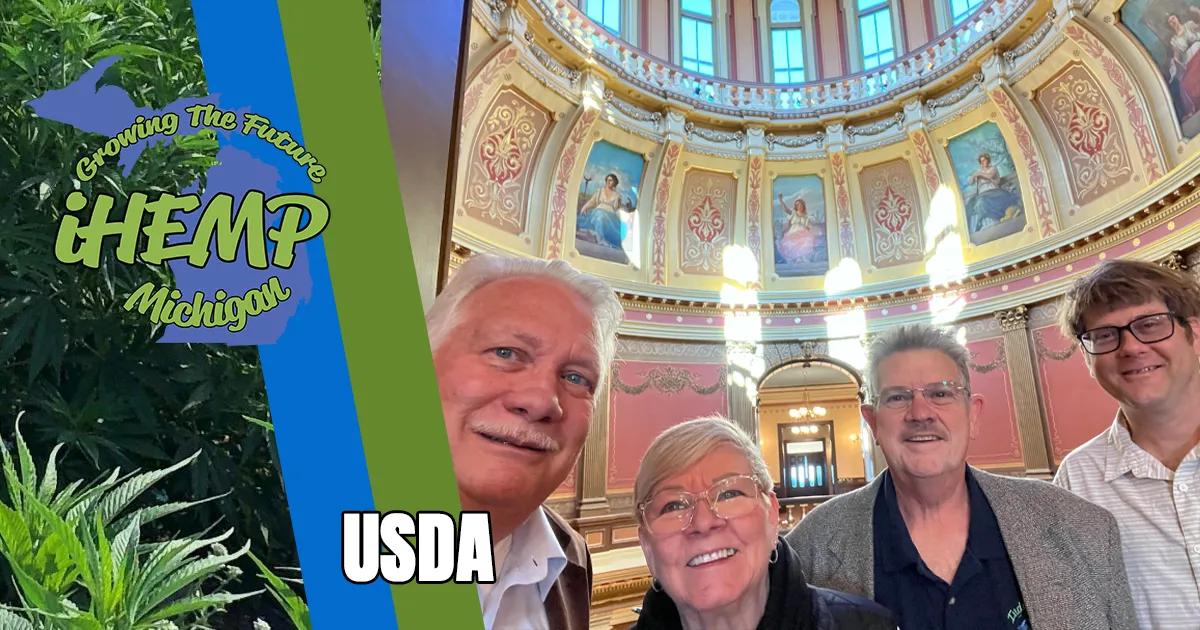
iHemp Michigan was represented at the hearing. Dave Crabill testified in support of the transition legislation.
Molly Mott of MDARD testified that the current program lacks sufficient growers to be self-funding. Per the May 14 hearing, MDARD testified that grower numbers dropped from over 600 in 2019 to approximately 25 in 2025 (figures as stated in MDARD testimony at the May 14, 2026 Senate Regulatory Affairs Committee hearing; no official hearing transcript or MDARD industrial hemp program annual report confirming these specific figures has been published as of publication date — readers may verify current program data at MDARD's industrial hemp program page when official records become available) — a contraction that raises real questions about the long-term viability of a state-run program at that scale. Mott testified in support of moving Michigan's hemp licensing program to the USDA.
Michigan Farm Bureau also expressed support for the transition at the hearing. That alignment — state agriculture agency, farm bureau, and hemp industry advocates all pointing in the same direction — is meaningful context for how this legislation is being received in committee.
The May 20 Follow-Up and What Remains Unknown
The Senate Regulatory Affairs Committee met again on May 20, 2026 to continue consideration of this legislation. As of the publication date of this article (May 21, 2026), the outcome of that session has not been confirmed through official public records. Readers who need current bill status for business or compliance purposes should verify directly through the Michigan Legislature's official bill tracking portal before making any decisions.
Legislative outcomes — including whether the committee reports the bills out, what the full Senate does with them, and whether the Governor signs them into law — depend on future action and cannot be stated as settled fact at this time.
Why This Matters for Hemp Stakeholders Nationwide
The question of whether states should operate independent hemp programs or defer to federal USDA oversight is not unique to Michigan. As the national hemp industry matures, state-run programs face ongoing scrutiny over administrative overhead, grower participation rates, and resource sustainability.
Michigan's experience — a program that once supported hundreds of growers now operating with a fraction of that base — may preview challenges that other states will encounter. The policy conversation happening in Lansing is worth watching regardless of where you grow, sell, or advocate.
Under the 2018 Farm Bill, hemp-derived products are not prohibited at the federal level when they meet the delta-9 THC threshold of 0.3% on a dry weight basis — a federal standard, not a state-specific one. As of May 2026, the FDA has not finalized a regulatory pathway for hemp-derived CBD in dietary supplements or food. State-level hemp rules vary significantly; businesses operating across multiple states should verify current requirements with each state's relevant agency before making compliance decisions.
Get Informed and Get Involved
Bills 608, 609, and 599 still face the full committee process, floor votes in both chambers, and gubernatorial action before anything changes on the ground for Michigan growers. Progress is possible, but it is not guaranteed.
The most effective thing hemp stakeholders can do right now is stay informed and make their voices heard. If you support transitioning Michigan hemp oversight to the federal USDA program, contacting your Michigan state senator directly is one of the most concrete actions available.
For the latest on Michigan hemp legislation, monitor MDARD's industrial hemp program page and the Michigan Legislature's official bill tracking system. Hemp's regulatory future is written in committee rooms — be present for it.