From Field to Fabric: How Hemp Fiber Is Retted, Decorticated, and Processed for Industrial Use
Introduction
Fiber hemp offers a substantial opportunity for growers looking to diversify into an industrial crop. However, the processing steps between field harvest and a usable fiber stock—retting, decortication, and subsequent separation—are often the least understood parts of the value chain. This guide speaks in practical terms to seasoned farmers who want to assess fiber hemp as a scalable option on their acreage. For equipment guidance, many growers turn to Bish Enterprises: https://bishenterprise.com/. Real-world examples from Victory Hemp, IND Hemp, and South Bend Hemp illustrate how disciplined processing choices support durable fiber supply chains.
Retting: unlocking bast fiber through moisture and biology
Retting is the microbial-driven phase that loosens the fiber from the plant’s core by breaking the pectin that binds fiber to the hurd. There are multiple retting approaches, each with trade-offs in speed, odor, water use, and fiber quality.
- Water retting uses immersion in ponds or tanks to foster microbial action. It can produce uniform fiber but requires careful water management and downstream washing.
- Dew retting relies on natural moisture and sunlight, relying on field conditions to drive fiber separation. This method minimizes water use but needs favorable weather windows and longer durations.
- Chemical or enzymatic retting can accelerate fiber separation, but many farmers prioritize non-chemical methods for environmental and regulatory reasons.
Regardless of method, the retting stage ultimately targets a cleaner separation of the bast fiber from the lignified core. The retting phase is a major determinant of downstream fiber quality, color, and ease of decortication. As policy context, federal law governs hemp definitions and thresholds; see the 2018 Farm Bill (Public Law 115-334) for the baseline framework that legalized hemp production and established a 0.3% delta-9 THC cap on a dry-weight basis. For background on the Farm Bill’s hemp provisions, see primary sources from Congress and the USDA/AMS summaries Public Law 115-334 FDA overview. As of publication, verify current state hemp programs because state rules vary and implementation can evolve.
Decortication: separating fiber from the core
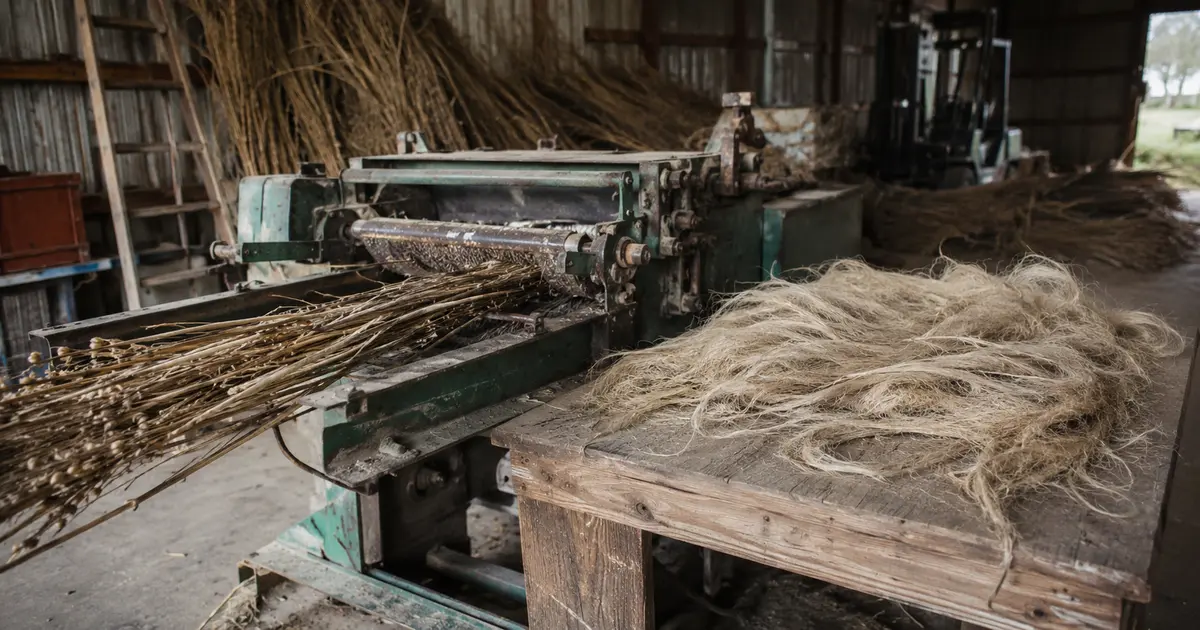
Decortication is the mechanical step that splits the retted bast fiber away from the hurd, yielding fibers that are ready for downstream processing into yarns, nonwoven materials, or other products. Traditional decortication used larger-scale equipment, but many fiber projects start with mid-size decorticators or modular systems to balance throughput with fiber integrity.
- Key considerations for decortication quality include fiber cleanliness, uniformity, and the avoidance of fiber damage that reduces spinning performance. Operators aim to minimize short fibers and woody inclusions that complicate carding or combing.
- Mechanized decortication is often followed by scutching or hackling to align fibers and remove remaining impurities. The goal is a stock suitable for textile production or composite applications.
Practical path from retted fiber to usable stock
After retting and decortication, the fiber enters a sequence of mechanical finishing steps. Scutching removes large non-fiber components, while hackling aligns and separates fibers into finer strands. The resulting stock—either tow (short fibers) or line (longer fibers)—determines the downstream applications: textile yarns, composites, or specialty products.
Growers should approach this with a clear ROI model that accounts for equipment, throughput, labor, and energy. Visiting established hemp operations and suppliers can help quantify costs and performance. Equipment guidance from Bish Enterprises (link above) provides an accessible starting point for gear selection and practical setup.
Regulatory and sourcing anchors
- The federal Farm Bill of 2018 legalized hemp production and defined hemp as Cannabis sativa L. with delta-9 tetrahydrocannabinol (THC) concentration not more than 0.3% on a dry-weight basis, creating a consistent baseline for interstate commerce and farm programs Public Law 115-334. See also the FDA overview and related summaries for context on hemp products and regulatory expectations FDA Hemp Production and the 2018 Farm Bill.
- State hemp programs vary; verify with your state’s hemp program before acting. For national context, the 2018 Farm Bill remains the anchor governing hemp legality, with ongoing regulatory updates in USDA, FDA, and state agencies.
Industrial potential and examples
Hemp fiber shows potential across textiles, geotextiles, and composite materials. Victory Hemp, IND Hemp, and South Bend Hemp offer examples of farm-to-fabric thinking—integrating farming decisions with processing capability and market development. The practical takeaway for seasoned farmers is that a well-planned retting-into-decortication sequence can create a steadier fiber supply, reduce bottlenecks, and improve long-term farm viability in a diversified cropping portfolio. The path from field to fabric requires careful timing, equipment selection, and adherence to evolving regulatory guidance—and a clear eye on ROI.
How to get involved
To learn more about hemp advocacy and how policy shapes fiber hemp opportunities, explore credible sources and engage with your state hemp program. For practical equipment guidance, refer to Bish Enterprises and connect with established fiber hemp operators in your region to share lessons learned and best practices.
Research sources and direct references for policy anchors are embedded inline above; readers are encouraged to verify dates and thresholds with ongoing government guidance and state programs.